
How to Check Criminal History in Racine
Begin a Racine search with the agency and kind of record shown on the citation, crash exchange, report number, or other paperwork. Racine Police Department records cover Racine police activity. Racine Municipal Court handles city ordinance violations and citation payments. A person taken into custody may appear in the county jail locator, while a filed felony or state misdemeanor belongs in Racine County Circuit Court. Wisconsin's person-centered criminal-history response is a separate state product.
- Use the Racine Police service that matches the task: a new online report, an accident report, a records request, an active-warrant tool, or crime mapping.
- Ask RPD for the existing narrative or incident material, giving the date, place, subject, and report number when known.
- Use the municipal citation payment route or contact the municipal counter for a city ordinance matter.
- Check the Racine County Jail locator after a custodial booking, or WCCA after state charges are filed.
- Use Wisconsin DOJ's WORCS only when a statewide, person-centered repository response is the actual goal.
These Racine steps prevent a common mismatch. Filing a Racine police report does not retrieve a prior report. A Racine payment screen is not a public docket. A calls-for-service point does not prove an arrest. For county-level custody and court depth, the Racine County criminal history routes explain those next systems.
Racine Records Near Center Street
Downtown Racine places several record offices close together, but their files remain separate. RPD is at 730 Center Street, Racine, WI 53403. The county courthouse is at 730 Wisconsin Avenue, and the Law Enforcement Center and jail are at 717 Wisconsin Avenue. A short walk does not make those counters interchangeable. RPD holds city incident work. The Clerk holds circuit cases. The sheriff holds county jail and sheriff records. The municipal system handles city citations.
The Racine distinction affects both speed and accuracy. A request for a Racine Police narrative sent to the circuit clerk will not produce the city report. A Racine felony complaint requested from police may omit the later motions and disposition held by the court. A jail profile records custody, not the full incident narrative. Name the Racine document sought before choosing the door or online form.
The official Racine Police services hub shows the department's separate Racine records, warrant, crash, mapping, and reporting routes.
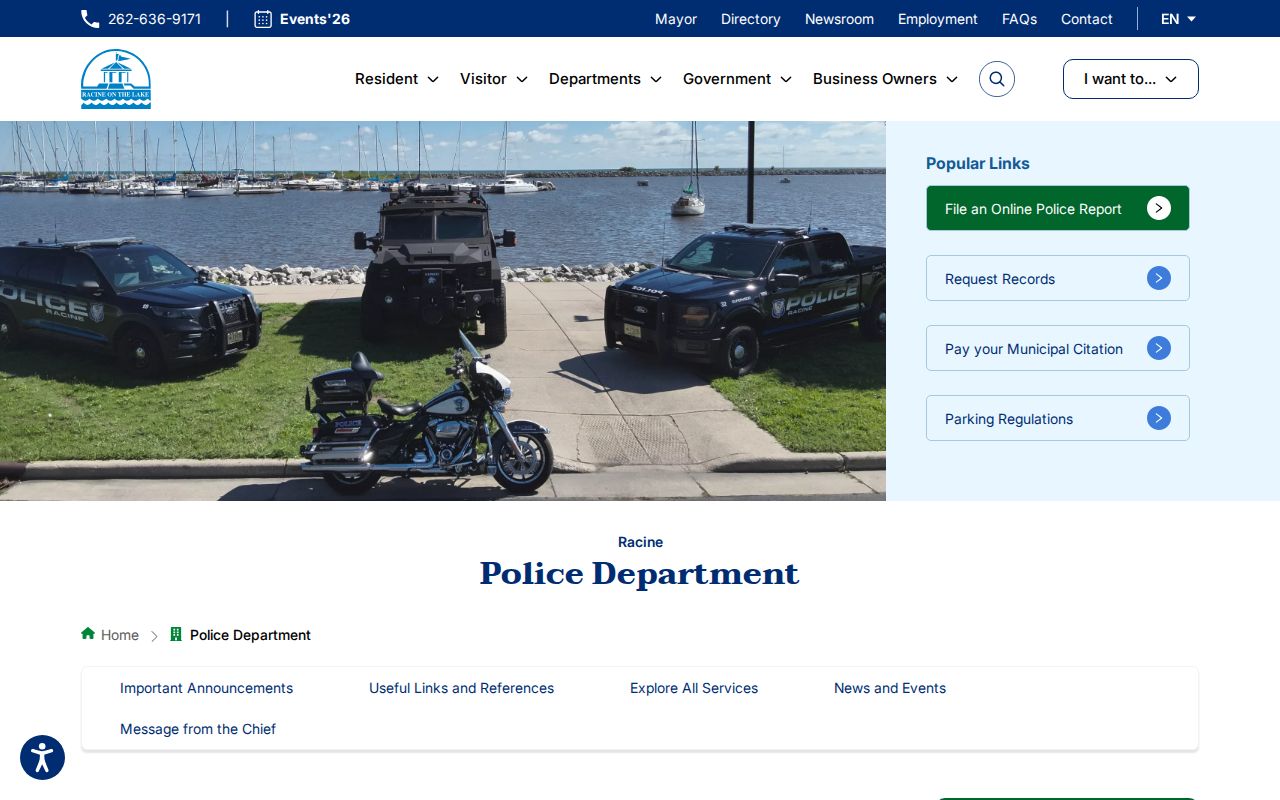
The menu is most useful as a set of task-specific entrances, not as one combined Racine criminal records database.
The Racine Police Department
Racine Police's Records Section sits within Support Services. The department's published material describes that Racine division as supporting records, courts, evidence and property, technology, communications resources, and customer service. General Racine information is available at 262-635-7700. Nonemergency communications uses 262-886-2300. For a Racine public-record request whose exact department route is unclear, Racine publishes publicrecords@cityofracine.org.
The Racine police hub separates Citizen Services online reporting, Accident Reports, Active Warrants, Annual Reports, Crime Mapping, Records, printable forms, municipal-citation payment, and parking-ticket payment. Each Racine channel has a narrower purpose. A requester should describe whether the desired item is a narrative, crash report, citation, photograph, audio, or video. Include the Racine incident date, location, subject, and report or call number when available. Legal review can remove juvenile, victim, witness, medical, or active-investigation information.
The official City of Racine source also presents the city-facing police service route captured below.
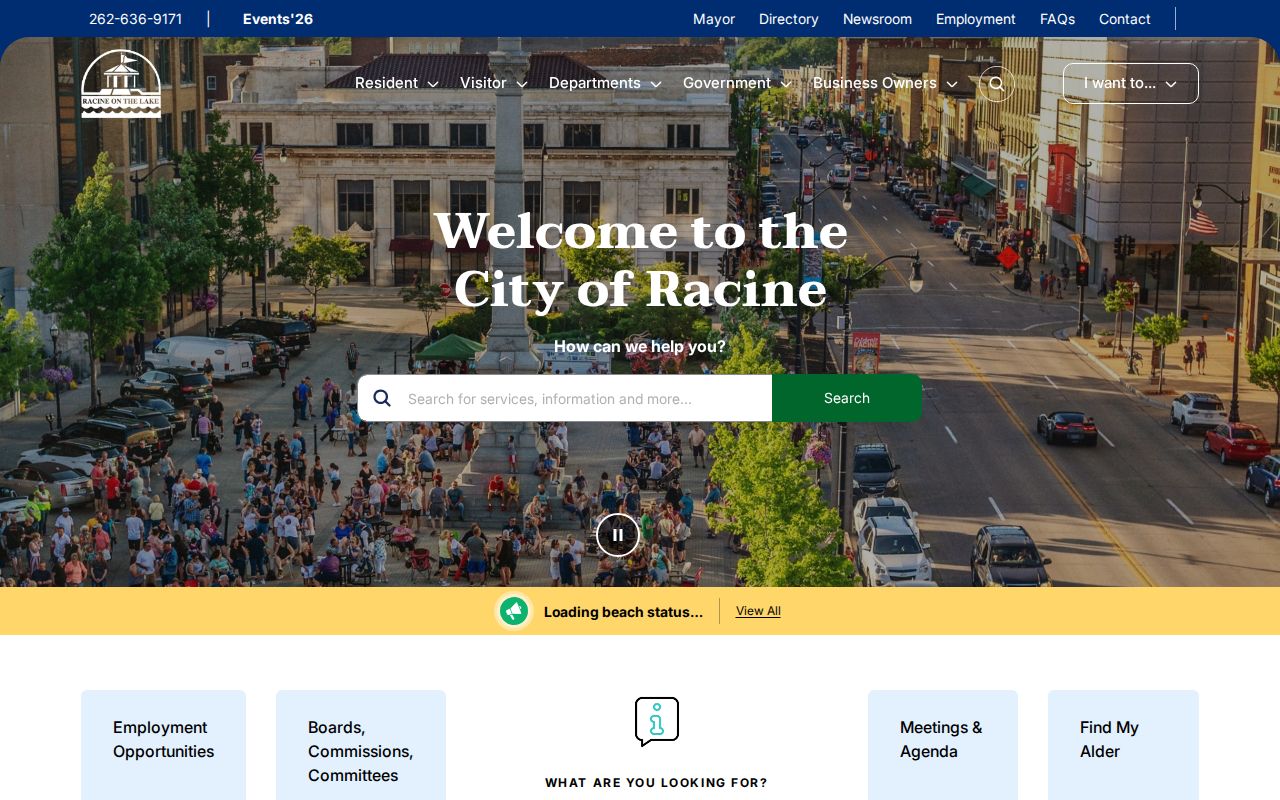
That city entry point is appropriate for RPD material; it does not replace the county jail, circuit clerk, or state repository.
Three Racine Police Record Paths
Racine residents often reach the Racine police hub with one of three different tasks. The online citizen-report tool creates a new Racine report for an eligible incident. The accident-report route concerns Racine crash material. A public-record request seeks an existing city record. Choosing among them matters because the fields, review, and result are not the same.
| Racine route | What it does | What it does not do |
|---|---|---|
| Citizen Services reporting | Submits a qualifying new incident to RPD | Does not fetch an existing police report |
| Accident Reports | Routes a request for crash material | Does not provide a full criminal history |
| Public-record request | Asks the city custodian for an identifiable existing record | Does not guarantee unredacted release |
The official Racine FAQ confirms that copies of accident and police reports are supported services. If the Racine menu does not make the right path clear, use the general city records email or call Racine Police. If the Racine incident began with a 911 call, CAD or dispatch audio may require a separate Racine County Communications request even though the police narrative remains with Racine Police.
Arrests and Bookings in Racine
Racine Police does not publish a Racine inmate roster or current city jail search. When a Racine arrest leads to custodial booking, the public starting point is the Racine County Jail locator. That county tool can show current custody details, charges, holds, bail or fine data, a court date, and a WCCA-linked case number. It warns that a Racine booking does not prove guilt.
The Racine report and booking entry answer different questions. Racine Police owns its incident narrative and related city evidence. The county jail documents Racine intake and custody. If the District Attorney files a felony or state misdemeanor, WCCA and the circuit file show the court stage. A Racine arrest can therefore become a county booking record without turning into a sheriff patrol report. Request the narrative from Racine Police, not Sheriff Records, when city officers created it.
A historical intergovernmental study said Racine Police had stopped its own fingerprinting and photographing and relied heavily on sheriff Records for noncustody processing. Treat that as Racine history, not proof of today's route in every case. Current Racine custody should always be checked in the live county system.
Reading Racine Police Service Calls
Racine Police's official ArcGIS legend includes accidents, alarms, abandoned vehicles, aggravated assaults, arson, burglary, disorderly conduct, drug abuse, fraud, homicide, robbery, search warrants, sex offenses, suspicious acts, TRO violations, welfare activity, and more. The Racine service defines a point as an assignment requiring public-safety presence. It supports Racine map queries, statistics, paging, and standard geographic formats, with a maximum of 2,000 records.
That technical reach does not change what Racine data means. A mapped Racine point may be a service call, may prove unfounded, may be reclassified, and may lead to no arrest or charge. Even labels such as “search warrant” describe a call category, not a public warrant affidavit or conviction. Verify the event through the Racine Police report, then use the jail locator if there was booking and WCCA if a case was filed.
The official calls-for-service legend provides the categories behind the Racine map.
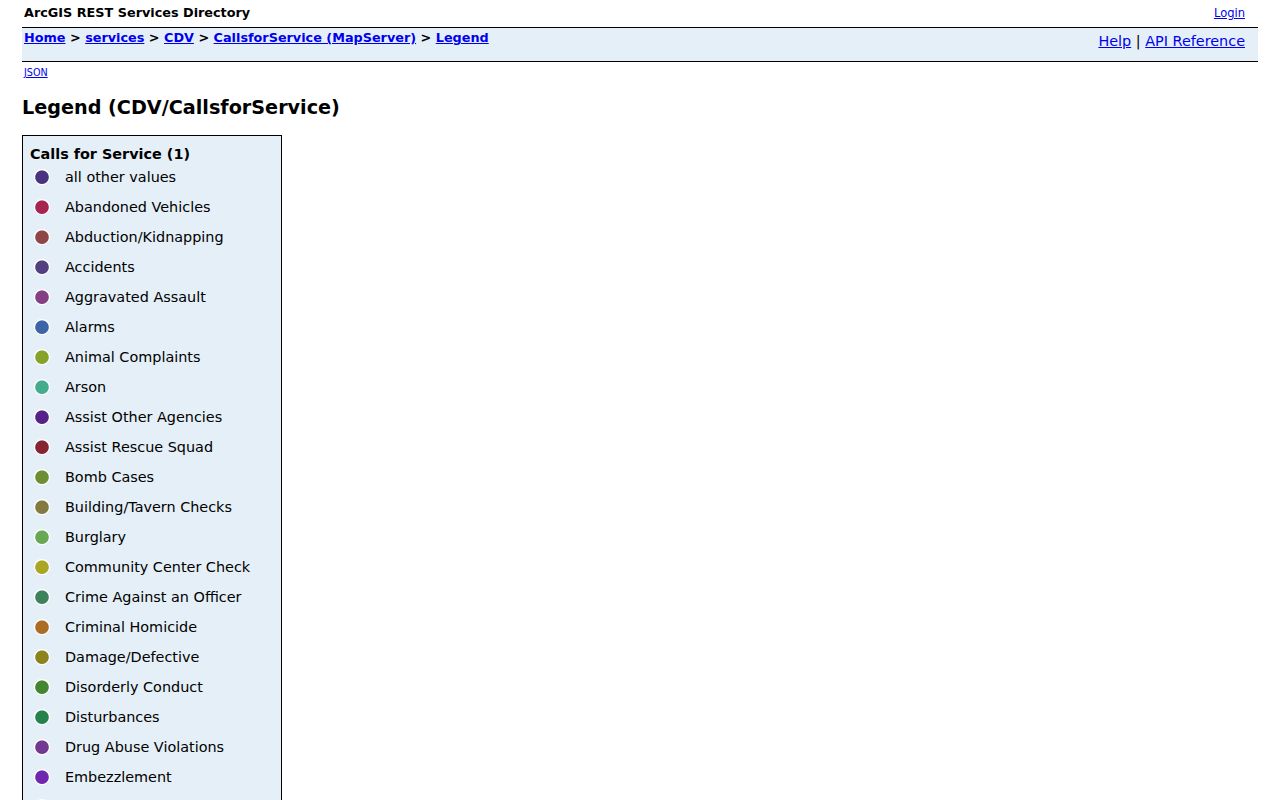
The captured Racine legend is a useful index to police activity, but no Racine point should be called a crime or conviction without the later record.
Racine Municipal Court Records
Racine Municipal Court handles city ordinance violations. Those matters are not Racine County felony or state misdemeanor prosecutions. RPD supplies a municipal-citation payment link, but the inspected official city pages did not provide a general public name-based municipal docket. Use the citation and payment channel, contact the municipal clerk or counter, or request the identifiable city record.
| Court | City of Racine Municipal Court. |
|---|---|
| Case types | Violations of city ordinances, including municipal citations. |
| Lookup channel | Citation/payment route, municipal clerk or counter, or city records request; no public name search was located. |
| Record contents | Citation facts, municipal proceedings, payment status, and disposition fields maintained by the city. |
| County boundary | Felony and state misdemeanor cases belong in Racine County Circuit Court and WCCA. |
WCCA should not be promised as complete coverage for local ordinance matters. The reverse is also true. Paying or tracing a city citation does not display a felony court file. Readers who need filed state-case events can use the separate Racine County criminal court case search.
Racine Complaint Form Is Different
RPD's Citizen Complaint Form is for accountability concerns about police conduct. It is not an incident-report request. The form instructs users to complete every blank, use UNK when a fact is unknown, and use NA when a field does not apply. Its affidavit must be notarized, and the completed packet returns to Internal Affairs at 730 Center Street.
Fields cover the complainant, date of birth, address and telephone; the incident date, time, and location; an officer name or badge; any arrested person and charges; witnesses and addresses; and a narrative. Those details help Internal Affairs assess a complaint. They do not produce a copy of the underlying police report. Use Records or the city public-record channel for that separate task.
The official RPD information source also confirms the department's public-facing records and local-history context.
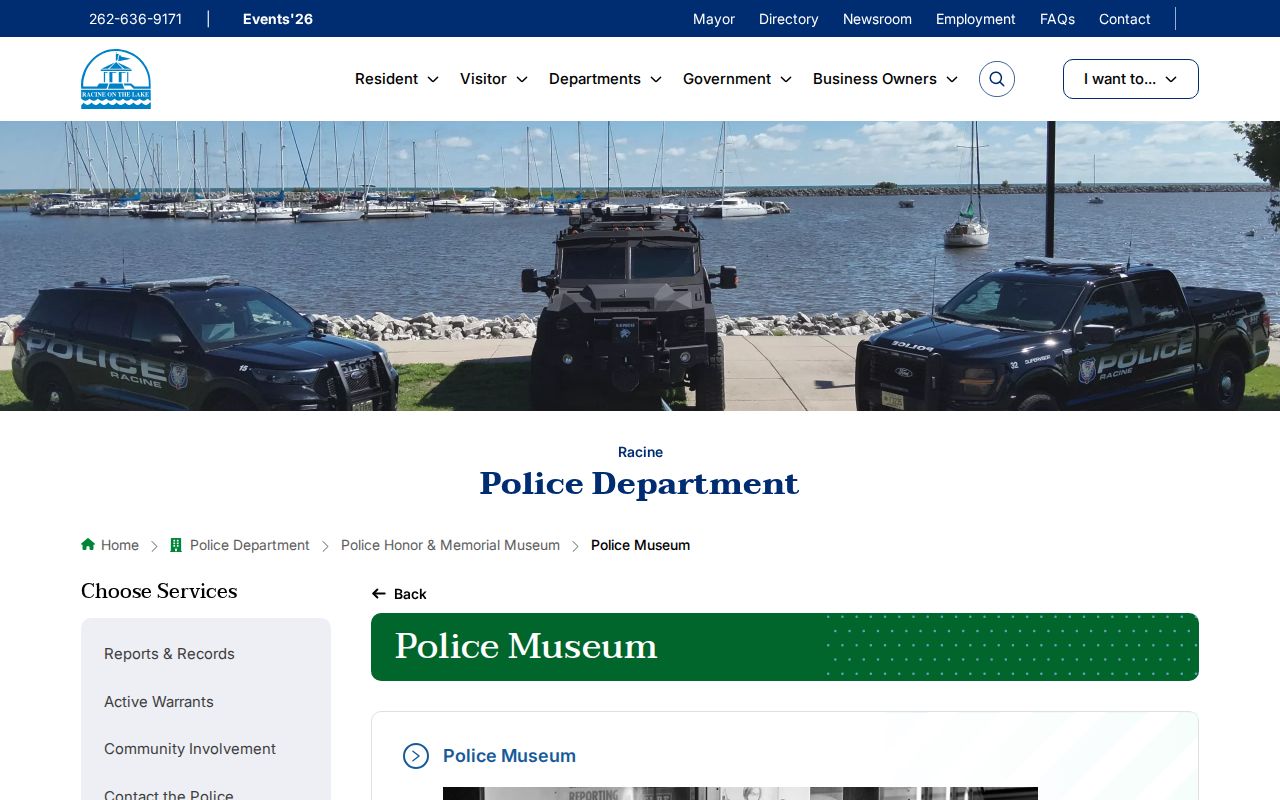
The image reinforces that report copies and department accountability forms are distinct public services with different outcomes.
Where Racine Records End Up
A Racine police event can generate several records as it moves through the justice system. RPD keeps its incident material. A custodial intake creates a Racine County Jail record. The District Attorney decides whether to file state charges, and the Circuit Court records hearings, pleas, motions, disposition, and sentence. Qualifying fingerprint and disposition submissions can then become part of the Wisconsin DOJ Crime Information Bureau's statewide history.
Record flow: Racine Police Department › Racine County Courts › Wisconsin Department of Justice, Crime Information Bureau
This line is a routing aid, not a promise that every call follows every step. A service call may end with no reportable offense. An ordinance citation may remain municipal. An arrest may not lead to a filed case. A statewide CIB response depends on qualifying submissions and fingerprints. Search the newest city event at its source, then move forward only when the next record was actually created.
Racine Crime Counts Need Context
RPD's 2023 annual report compares agency-reported counts, not people convicted. Total listed crimes fell from 1,675 in 2022 to 1,458 in 2023. Violent crime fell from 409 to 352, a reported 14 percent decline. Within that total, homicide moved from 10 to 12, aggravated assault from 234 to 200, rape from 90 to 102, and robbery from 75 to 38.
Property and traffic lines also moved in different directions. Burglary fell from 333 to 182, theft from 725 to 672, and arson from seven to four. Motor-vehicle theft rose from 201 to 248. Traffic citations fell from 5,547 to 5,339, while OWI citations fell from 284 to 156 and reckless-driving citations rose from 339 to 423. These changes show why a single headline can hide the record mix.
A reported count is not an arrest, and neither is a conviction. The report's extracted property-crime subtotal appears corrupted, so the published total and component figures are safer than repeating the damaged subtotal. Use the annual report for broad city context, then verify any individual event through RPD and its later court record.
Racine Police Records and Memory
RPD's lobby museum offers a different kind of city record. Photographs, video, artifacts, and a ten-foot honor wall preserve institutional history at the police building. The exhibit does not function as an incident archive or criminal search, but it helps explain how Racine has documented its police service over time.
The museum belongs at city altitude because it is tied to RPD and its own public story. Researchers seeking historical police context may find it useful before asking the department to identify an older record series. A modern report request still needs enough facts to describe an identifiable record, and ordinary retention or disclosure rules still apply.
Public Access Rules
Racine police and municipal records are governed by Wisconsin's presumption of public access, but the custodian must apply specific statutes and a public-interest balancing test. Ask for an identifiable record rather than broad answers. RPD may review and redact juvenile information, victim or witness identifiers, health data, active-investigation material, and other protected details. Audio, video, and dispatch data can also involve separate custodians.
Key Statutes:
Wisconsin Public Records Law, Wis. Stat. §§ 19.31-19.39 creates the access presumption and request process while allowing lawful withholding and redaction.
Wis. Stat. § 165.83 governs criminal-history reporting to the state repository and helps explain why city and CIB records differ.
Wis. Stat. § 165.84 addresses fingerprint submission, a key condition in Wisconsin's person-centered criminal-history system.
Public access does not make every file complete or immediate. A released RPD report may omit protected material, and an active case may still be changing. Compare the document with the municipal or circuit disposition before drawing a final conclusion about the event.